Antique and Vintage Diamond Cuts: History in Stone
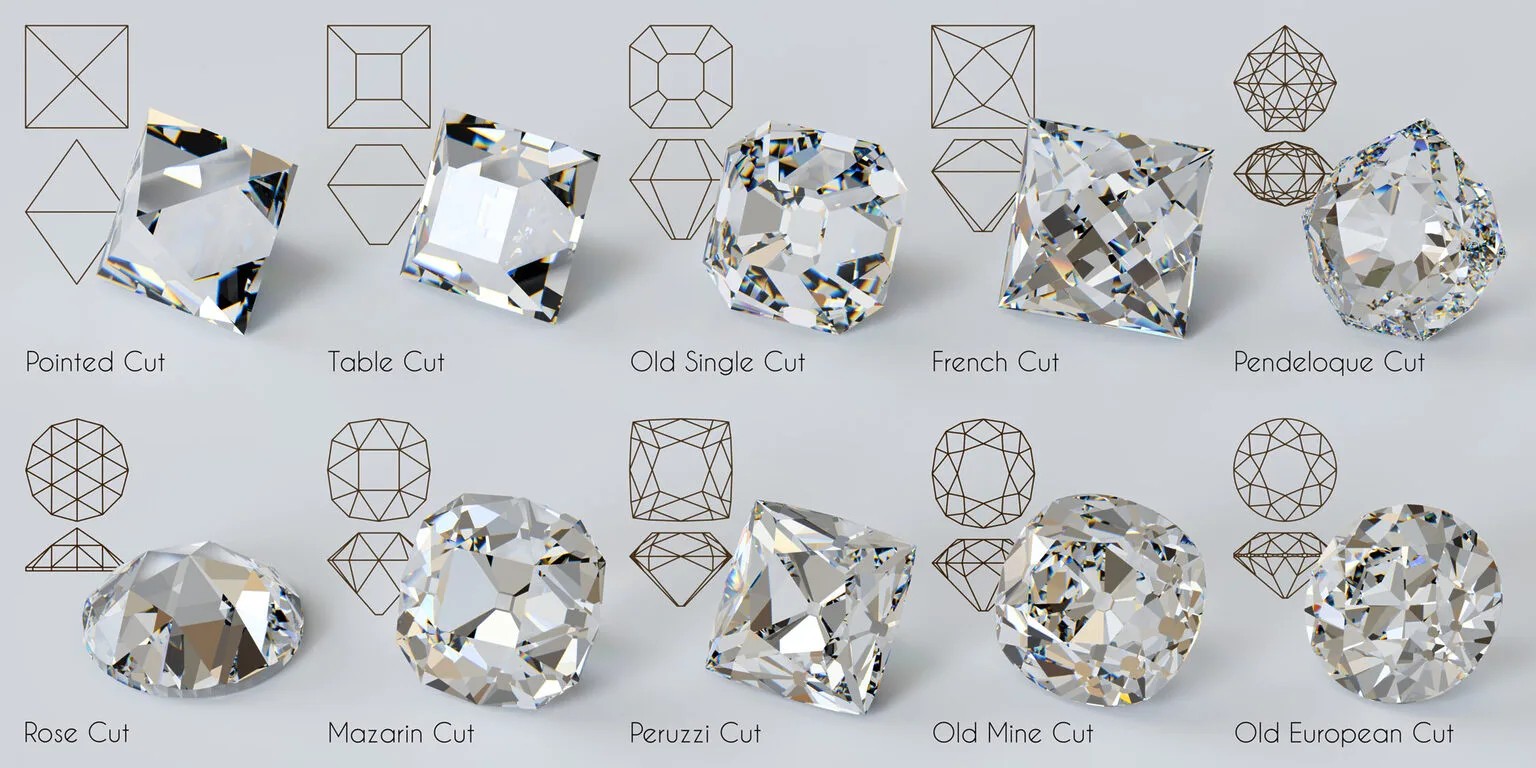
Antique and Vintage Diamond Cuts: A Short History in Stone
Before electric light, diamonds were seen by candle and fire. The old cutters shaped them for that soft, flickering world. Hand tools, not machines, did the work, so every stone was slightly different. Today, those old styles are popular again. Many people love their quirks: the glow, the personality, the story. Here’s a plain-English tour of the cuts that came before the modern round.
Antique, vintage, estate: what do the words mean? • Antique: generally over 100 years old. • Vintage: older than about 20 years, but under 100. • Estate: simply pre-owned, of any age.
Timeline at a glance Dates are approximate. Cutting styles evolved slowly and overlapped.
Cut Approximate era Key features
Point cut 1300s Natural octahedron crystal with its faces polished. Pointed top.
Table cut 1400s Top of the octahedron ground flat. Square outline.
Single cut 1500s onwards Table plus 8 facets on top; simple. Still used for tiny stones.
Rose cut 1500s Flat base, domed top with triangular facets, often 24.
Mazarin cut mid-1600s Early double-cut with about 34 facets. Cushion-like.
Peruzzi cut c. 1700 Credited to Venetian cutter Vincenzo Peruzzi. First with 58 facets.
Old mine cut 1700s to 1800s Cushion shape, high crown, small table, large open culet.
Old European cut late 1800s to 1930s Round, high crown, small table, large open culet.
Transitional cut 1920s to 1940s Between old European and modern round. Bigger table.
Asscher 1902 Square step cut with cut corners (see Blog 3).
Briolette Centuries old Teardrop faceted all over. No table or culet. Drilled for hanging.
The cuts, one by one Point cut and table cut The earliest diamonds were not so much “cut” as polished. A rough diamond often grows as a natural eight-sided shape called an octahedron. Early craftsmen polished its natural faces to make them shine, creating the point cut. Later, they ground the top point flat to make a square table cut. These stones are rare and often found in museums and very old jewellery.
Single cut A simple style with a flat table and eight facets on the top, plus eight on the bottom. It is basic, but quietly charming. Today single cuts are mostly found as tiny accent stones in vintage jewellery and watches.
Rose cut Dating back to around the 1500s, the rose cut has a flat base and a domed top covered in triangular facets that meet at a point, like the petals of a rosebud. The classic rose has 24 facets. It was hugely popular in Georgian and Victorian jewellery. Rose cuts don’t sparkle in the way a brilliant does. Instead, they give a soft, silvery glow, and they have returned to fashion for their understated, romantic look. Good to know: the flat back means they often appear larger than their weight.
Mazarin and Peruzzi cuts These are early “double-cut” styles, with facets on both the top and bottom of the stone, from the 1600s and early 1700s. The Mazarin cut, named after the French cardinal and statesman Jules Mazarin, has around 34 facets. The Peruzzi cut is traditionally credited to Vincenzo Peruzzi of Venice and is recognised as the first to reach 58 facets, the same number as a modern round brilliant. They’re extremely rare in jewellery, but important in the history of the diamond.
Old mine cut The most characteristic antique style. It is a cushion shape with a high crown, a small table and a deep pavilion with a large, open culet (the point at the bottom, cut flat so that you can see through it). Diamond discoveries in Brazil in the 1700s increased supply, and old mine cuts were the fashion for generations. Because the facets were hand-polished, no two are the same. Under candlelight, an old mine cut gives a warm, glimmering, almost liquid flash.
Old European cut The round version, popular from the late 1800s into the 1930s. It’s the direct ancestor of the modern round brilliant, but with a higher crown, a smaller table and a larger open culet. Better tools allowed rounder and more precise stones than earlier styles. The look is chunky and full of character, with bold flashes of light.
Transitional cut Between about the 1920s and 1940s, cutters began moving towards the proportions of the modern round brilliant. The result was the transitional cut: a bigger table and a smaller culet than an old European cut, but not yet as precise as today’s stones. It combines vintage charm with a little more sparkle.
Asscher Created in 1902 by Joseph Asscher in Amsterdam, and a hallmark of the Art Deco era. See Blog 3 for the full story. Original antique Asschers are distinct from the modern Royal Asscher because of their softer, more individual look.
Briolette A teardrop-shaped stone faceted all over, with no flat table and no culet. A tiny hole is drilled through the top so that it can hang from a wire or chain. Briolettes have been used for centuries in both Indian and European jewellery, particularly in pendants and drop earrings. They are loved for their movement: as they swing, they catch the light from every angle.