Diamond Shapes Explained: A Buyer’s Guide
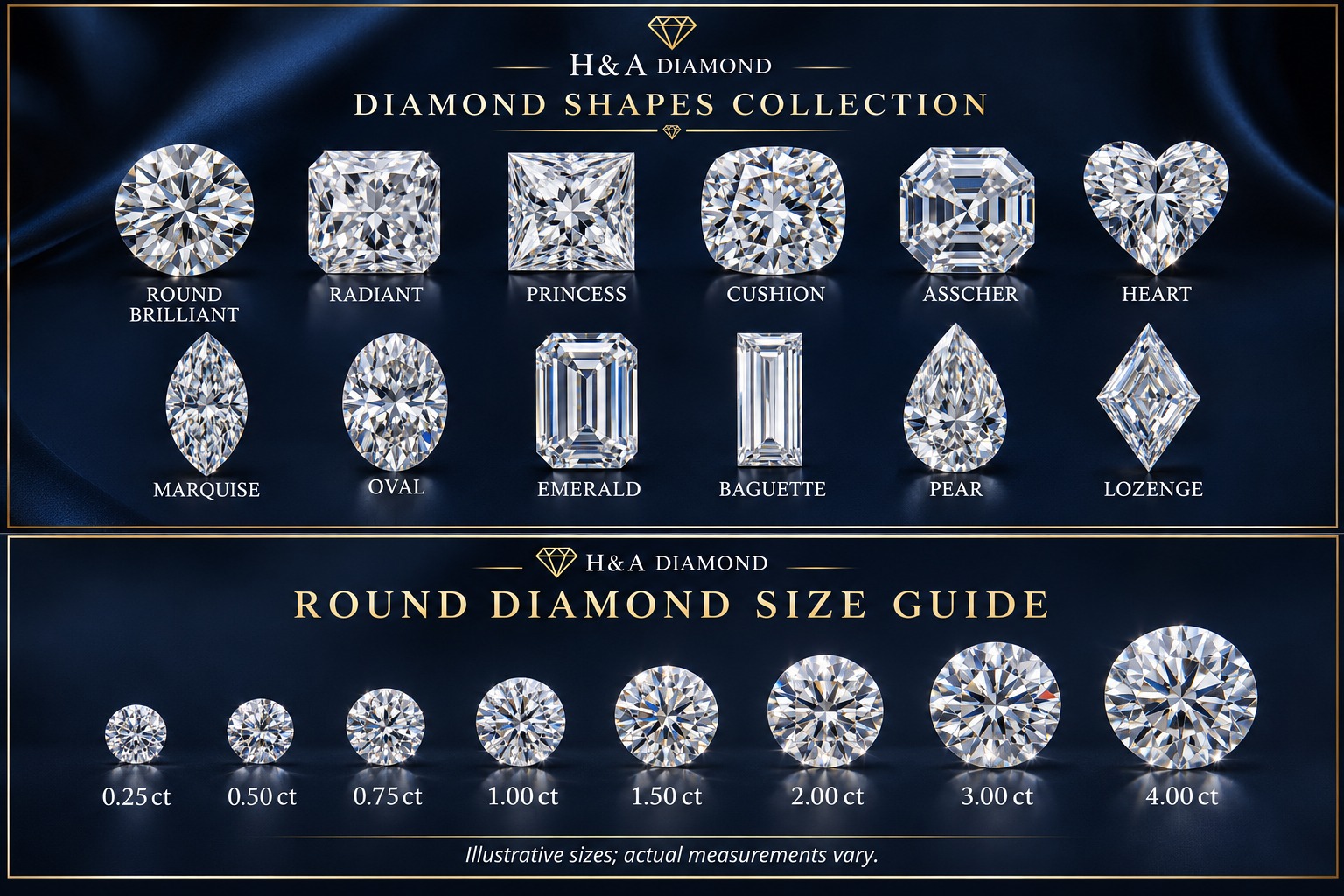
Diamond Shapes Explained: A Plain-English Guide to Every Popular Shape
Walk into any jeweller and the first question is usually: “Which shape do you like?” It sounds simple, but it’s the choice that changes how a diamond looks, how large it seems, and how much you pay. Let’s make it easy.
Shape and cut are not the same thing People mix these up all the time. Shape is the outline you see from above: round, oval, pear and so on. Cut is about quality: the proportions, symmetry and polish that decide how well the diamond handles light. Any shape can be well cut or badly cut. Always check both.
Two families: brilliant and step • Brilliant cuts (round, oval, pear, marquise, cushion, heart, princess, radiant) use many small, triangular facets. The effect is lively sparkle. • Step cuts (emerald, Asscher) use long, rectangular facets arranged like stairs. The effect is a calm, glassy “hall of mirrors” flash. They show off clarity and colour, so there’s less room to hide flaws.
Quick reference
Shape Look and feel Worth knowing
Round brilliant Classic, maximum sparkle Usually the highest price per carat
Princess Modern, sharp, square Corners can chip; protect them with prongs
Cushion Soft, romantic, pillow-like Choose between crisp and soft facet styles
Oval Elegant, elongated Looks larger than a round of the same weight
Emerald Understated, sophisticated Choose higher clarity; flaws are easy to see
Asscher Square step cut, Art Deco Very clear stone needed; deeper than emerald
Radiant Rectangular with sparkle Hides small inclusions better than step cuts
Pear Teardrop, graceful Check the “bow-tie” and the point
Marquise Long, dramatic, boat-shaped Great finger coverage; points need protection
Heart Romantic, playful Needs enough size to show the shape clearly
The shapes, one by one Round brilliant The most popular shape in the world, and the most studied. In 1919, the Belgian cutter and mathematician Marcel Tolkowsky published calculations for ideal proportions that still influence round cuts today. With 57 or 58 facets, a well-cut round returns more light to the eye than any other shape. Because a lot of the rough stone is lost when cutting a round, it generally costs more per carat than fancy shapes. Best for: those who want maximum sparkle and a timeless look.
Princess A square (or slightly rectangular) brilliant with pointed corners. Earlier square brilliants existed in the 1960s and 70s, and the version we know as the princess cut is generally credited to designers in the late 1970s. It quickly became the go-to modern alternative to the round. Watch for: vulnerable corners. A good setting with prongs at each corner protects them. Best for: a clean, contemporary look with plenty of sparkle.
Cushion A square or rectangular shape with rounded corners, like a soft pillow. It is a direct descendant of the antique old mine cut (see Blog 4) that was fashionable throughout the 1800s. It fell out of favour in the 20th century, then returned in the 2000s. Modern cushions come in styles from “chunky” facets to a shimmering “crushed ice” look. Best for: a romantic, vintage-inspired feel.
Oval An elongated brilliant. Oval-shaped stones existed for centuries, but the modern oval brilliant is often credited to cutter Lazare Kaplan in 1957. Because it is stretched, an oval’s top surface is large for its weight, so it looks bigger than a round of the same carat. It also makes the finger look longer. Watch for: the “bow-tie”, a darker band across the middle. Many buyers prefer a length-to-width ratio of roughly 1.30 to 1.50. Best for: getting a larger look for the same budget.
Emerald A rectangle with trimmed corners and long, stepped facets. The style was developed for cutting emerald gemstones, which are naturally brittle, and the stepped design protects them. It became strongly associated with the Art Deco period of the 1920s and 30s. The effect is a calm flash of light rather than sparkle, and it reveals every flaw. Watch for: choose a high clarity grade and check that the stone looks clean to the eye. Best for: understated, architectural elegance.
Asscher A square step cut with cut corners and a high crown. It was created in 1902 by Joseph Asscher in Amsterdam. The Asscher family firm was also entrusted with cutting the enormous Cullinan diamond in 1908. The Royal Asscher cut, a more modern version with 74 facets, was introduced in 2002. Best for: Art Deco lovers and those who like a vintage look with a clean, geometric shape.
Radiant Created in 1977 by the cutter Henry Grossbard in New York, the radiant combines the elegant outline of an emerald cut with the sparkle of a brilliant. Its faceting is more forgiving of small inclusions than a step cut. Best for: those who like the rectangular outline but want more fire.
Marquise A long, boat-like shape with pointed ends, also called “navette”, the French word for little boat. According to legend, King Louis XV of France commissioned this shape in the 1740s to mirror the smile of his mistress, the Marquise de Pompadour. Historians can’t prove the story, but the name stuck. Marquise stones give excellent finger coverage and look large for their weight. Watch for: both points are delicate, so a protective setting is wise, and check for a strong bow-tie. Best for: a dramatic, vintage-inspired look.
Heart The symbol of love, in stone. Heart-shaped gems appear in jewellery from medieval times onward. Cutting a good heart takes real skill: the cleft at the top must be sharp and both lobes must be symmetrical. Small hearts can look less defined, so many jewellers suggest choosing a larger size. Best for: a sentimental gift, often as a pendant.
Pear shape: a closer look The pear, also called the teardrop, is a mix of two other shapes: a round end and a marquise-style point. It is one of the oldest fancy shapes in history.
A short history • The pear shape is traditionally credited to the Flemish cutter Lodewyk van Bercken (sometimes spelled van Berquem), working in the city of Bruges around the 1470s. He is also associated with the scaif, a polishing wheel that allowed cutters to put symmetrical facets on stones. Historians debate some of the details, but his name is closely tied to the shape. • The Cullinan I, also known as the Great Star of Africa, is a 530-carat pear-shaped diamond cut from the largest gem-quality rough diamond ever found (found in South Africa in 1905). It is set in the Sovereign’s Sceptre, part of the British Crown Jewels. • The Taylor-Burton diamond, a 69-carat pear shape, was bought by the actor Richard Burton for Elizabeth Taylor in 1969, which made the pear fashionable in modern jewellery again.
Where pear shapes are used • Pendants. A pear naturally hangs with its point downwards, which is why it’s a top choice for necklaces. • Drop earrings. A matched pair of pears is elegant, but matching two stones takes patience. • Engagement rings. As a solitaire, in a halo, or as the centre of a three-stone ring. • Cocktail rings and vintage-style jewellery. The shape suits Victorian and Art Deco designs. • As side stones, framing a larger centre diamond.
Buying tips for a pear • Look for a length-to-width ratio of roughly 1.45 to 1.75. Lower looks plump, higher looks slim. • Check the bow-tie, the dark band across the centre. A faint one is normal; a strong one is distracting. • Check symmetry: the two shoulders should match and the point should line up with the centre of the rounded end. • Protect the point, which is the most delicate part. A V-shaped prong is the usual solution. • Traditionally the point faces the fingertip, which lengthens the finger. Some modern wearers turn it the other way. Both are fine.
Other shapes you may meet • Trilliant (triangle): a three-sided brilliant, often used as side stones. • Baguette and tapered baguette: narrow step-cut rectangles, widely used as side stones and in Art Deco jewellery. • Kite, shield, half-moon and hexagon: less common shapes that are growing in popularity for unusual designs.